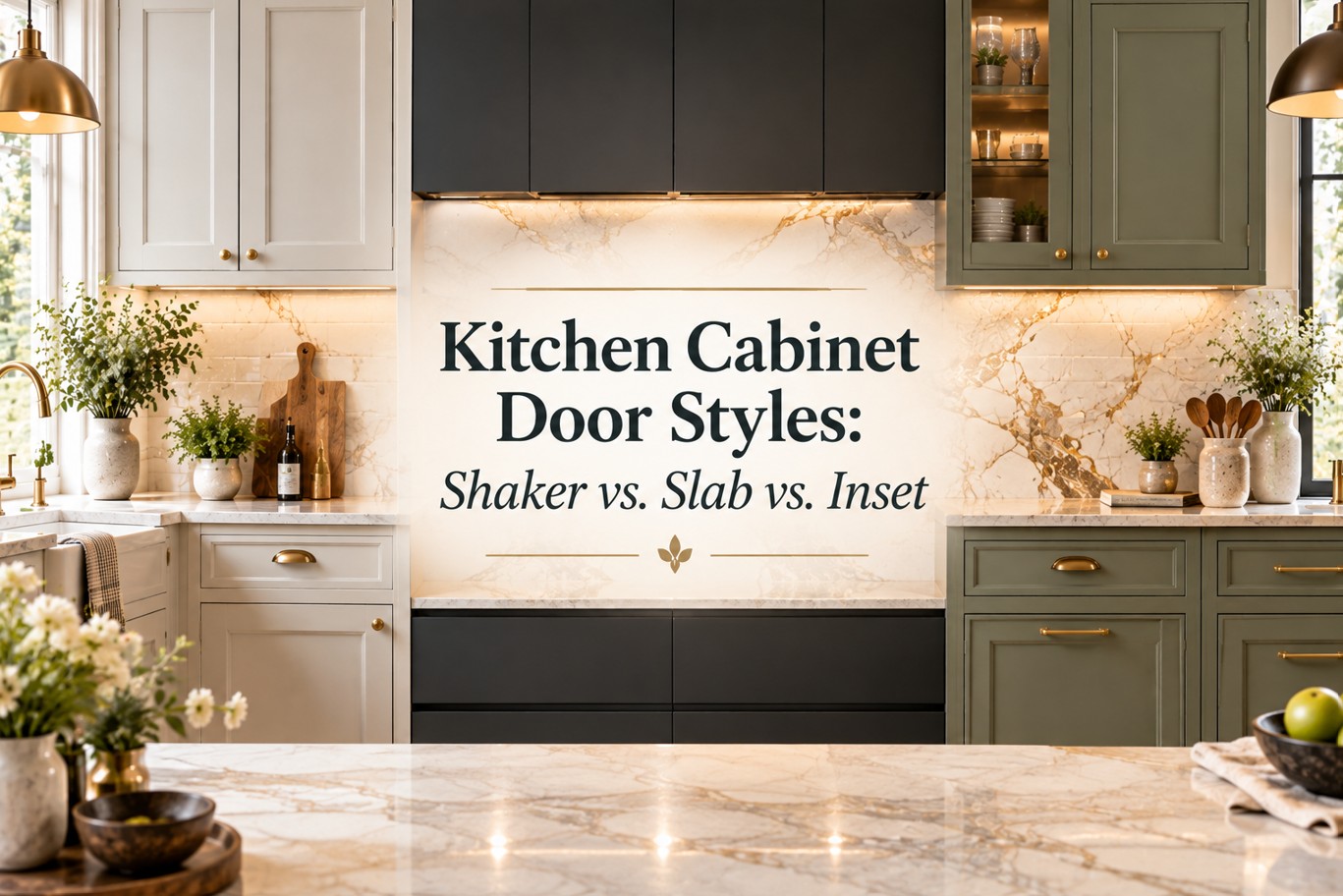
Kitchen Cabinet Door Styles: Shaker vs. Slab vs. Inset
Choosing kitchen cabinet door styles is one of the most important decisions in a kitchen remodel. Cabinet doors cover a large portion of the room’s visible surfaces, so their shape, proportions, finish, and installation style can influence the entire design.
But there is one detail many homeowners overlook: Shaker, slab, and inset do not describe the same type of design decision. Shaker and slab describe the door profile, while inset describes how the door fits into the cabinet frame. Understanding this difference makes it easier to compare options, evaluate quotes, and create a kitchen that looks intentional rather than assembled from unrelated trends.
In this guide, we compare the most popular kitchen cabinet door styles, explain their advantages and trade-offs, and show how to choose the right combination for a modern, traditional, or luxury kitchen.
Quick Answer: Which Kitchen Cabinet Door Style Is Best?
The best cabinet door style depends on your home’s architecture, the look you want, your maintenance preferences, and your budget.
- Shaker cabinets: A versatile choice for transitional, traditional, and contemporary kitchens.
- Slab cabinets: Ideal for modern interiors that emphasize clean lines and uninterrupted surfaces.
- Inset cabinets: Best for homeowners who appreciate precise, furniture-like detailing and a more tailored appearance.
- Slim Shaker cabinets: A contemporary alternative that keeps the framed look but reduces visual weight.
- Raised-panel cabinets: A traditional option for kitchens with more decorative architectural details.
One important distinction: inset is an installation configuration, not a door profile. A Shaker door can be inset, and a slab door may also be available in an inset configuration, depending on the cabinet system.
1. Shaker Kitchen Cabinets: Timeless and Versatile
Shaker cabinet doors feature a flat center panel surrounded by a simple frame. Their restrained detailing gives them more dimension than a completely flat door without the elaborate ornamentation of traditional cabinetry.
That balance is why Shaker remains a dependable option for many North American homes.
What makes Shaker cabinets appealing?
Shaker doors can work in a range of interiors. White or warm-neutral Shaker cabinets complement transitional kitchens, while natural wood versions introduce texture and warmth. Dark green, navy, charcoal, and other deeper finishes can create a more dramatic look.
They also offer flexibility when you update other elements of the room. You can change hardware, lighting, countertops, or wall colors without necessarily making the cabinet profile feel out of place.
What should you consider before choosing Shaker?
The recessed panel and inside corners create small areas where dust and cooking residue can collect. Painted finishes can also require occasional touch-ups, particularly around frequently used doors and drawers.
For a more contemporary appearance, consider slim Shaker doors with narrower frames. They retain the familiar framed detail while making the cabinetry feel lighter and less traditional.
Best for: Transitional kitchens, classic white kitchens, warm contemporary interiors, and homeowners who want a design with long-term flexibility.
2. Slab Kitchen Cabinets: Clean Lines for Modern Interiors
Slab cabinet doors have flat, uninterrupted faces without a framed center panel. Their simplicity makes them a natural fit for minimalist, contemporary, and modern luxury kitchens.
Because the surface has fewer visual details, the finish becomes especially important. Wood grain, matte lacquer, subtle texture, and carefully selected colors can all become prominent design features.
Why choose slab cabinets?
Slab doors create a calm visual rhythm, especially when paired with consistent gaps, integrated appliances, and discreet hardware. They can also complement open-plan spaces where the kitchen needs to feel connected to the living and dining areas.
For a warm modern kitchen, consider natural oak or walnut tones. For a more architectural look, explore matte black, warm white, greige, or muted earthy finishes.
Are slab cabinets easier to maintain?
Their flat faces are generally straightforward to wipe because they lack the recessed corners found on framed doors. However, maintenance still depends on the material and finish. Glossy surfaces may show fingerprints, while dark matte finishes can reveal dust or certain marks under direct light.
The absence of decorative detailing does not automatically mean a cabinet is more durable. Door construction, edge quality, hardware, and installation remain important.
Best for: Contemporary kitchens, minimalist interiors, handleless designs, and homeowners who prefer simple geometry over decorative detailing.
3. Inset Kitchen Cabinets: A Tailored, Furniture-Like Finish
Inset cabinet doors sit inside the cabinet frame rather than covering its front edges. When closed, the door face is designed to align with the surrounding frame, creating a carefully ordered appearance.
This configuration often feels more like custom furniture than standard cabinetry.
What makes inset cabinetry different?
Inset cabinetry places greater visual emphasis on alignment, spacing, and craftsmanship. Because the door sits within the opening, the gaps around it are part of the finished design rather than something hidden behind an overlapping door.
The result can be especially beautiful in traditional, transitional, and heritage-inspired kitchens.
Does inset cabinetry cost more?
Inset cabinetry often carries a higher price because it requires precise measurements, construction, and installation. The cabinet system must accommodate consistent clearances, and door movement needs to be considered during fabrication and fitting.
Wood can respond to changes in humidity, so an inset installation should be designed and installed with the material’s behavior in mind. A higher price alone does not guarantee quality; ask about construction details, adjustment provisions, hardware, and installation tolerances.
Best for: Bespoke kitchens, traditional interiors, refined transitional designs, and homeowners who value precise detailing.
4. Full Overlay vs. Partial Overlay vs. Inset
This is where cabinet terminology often becomes confusing. Overlay and inset describe how a door relates to the cabinet frame, not the shape of the door itself.
Full overlay
Full-overlay doors cover most or nearly all of the cabinet face frame or front edges, depending on the cabinet construction. The visible gaps between doors are typically narrow, creating a clean, continuous appearance.
This configuration is common in contemporary cabinetry and can work with both Shaker and slab doors.
Partial overlay
Partial-overlay doors leave more of the cabinet frame visible between doors and drawers. The result is a more segmented appearance, which may suit certain traditional designs or existing cabinet systems.
Inset
Inset doors fit inside the cabinet frame. The frame remains visible around each door, and consistent spacing becomes an important part of the design.
| Feature | Full overlay | Partial overlay | Inset |
|---|---|---|---|
| Door position | Covers most of the cabinet front | Covers part of the cabinet front | Fits inside the frame |
| Visual effect | Clean, continuous | More visible framing | Tailored, furniture-like |
| Precision needs | Depends on the system | Depends on the system | Typically high |
| Design character | Modern to transitional | Often traditional | Traditional to high-end custom |
| Main consideration | Consistent reveals | Visible frame proportions | Precise fit and adjustment |
Designer tip: When comparing two cabinet quotes, ask the supplier to identify both the door profile and the mounting configuration. Comparing a full-overlay Shaker door with an inset slab door changes two variables at once, making it difficult to understand what is actually driving the price or appearance.
5. Slim Shaker Cabinets: A Modern Take on a Classic
Slim Shaker doors use the same basic framed construction as traditional Shaker doors, but the frame is narrower. This reduces the visual weight of the door and gives the kitchen a more contemporary character.
Slim Shaker can be a useful middle ground if slab cabinetry feels too minimal but traditional Shaker looks too heavy.
It pairs well with:
- Warm white and soft beige finishes
- Natural oak or walnut accents
- Simple pulls or discreet edge hardware
- Quartz or natural-stone countertops
- Minimal decorative trim
The key is proportion. A narrow frame should look intentional in relation to the cabinet dimensions, hardware, and surrounding finishes.
Best for: Transitional-modern kitchens, contemporary renovations, and homeowners who want subtle detail without an ornate appearance.
6. Raised-Panel Cabinets: Traditional Detail and Depth
Raised-panel cabinet doors feature a center panel that projects outward from the surrounding frame. Their layered profile creates more shadow and depth than Shaker or slab designs.
They can work beautifully in traditional homes, classic interiors, and kitchens with detailed moldings or other architectural features.
However, raised-panel doors can feel visually heavy in a room dominated by sleek appliances, minimalist lighting, and flat surfaces. If you prefer this style but want a lighter look, consider a restrained profile and a simpler finish.
Best for: Traditional homes, formal kitchens, and interiors where cabinetry is intended to feel decorative and architectural.
7. Glass-Front Cabinets: Adding Lightness and Display Space
Glass-front doors introduce transparency into a wall of cabinetry. They can break up a long run of solid doors and provide a place to display glassware, ceramics, or carefully arranged everyday pieces.
Glass-front cabinetry is best treated as an accent rather than an automatic replacement for every upper cabinet. Clear glass reveals the contents, while reeded or textured glass softens the view and can make organization less visually demanding.
Before choosing glass-front doors, consider lighting, shelf arrangement, fingerprints, and how much visible storage you want to maintain.
Best for: Feature cabinets, bar areas, selected upper cabinets, and kitchens that need a lighter visual balance.
8. How to Choose the Right Cabinet Door Style for Your Kitchen
The best choice is not necessarily the trendiest profile. It is the one that fits your home, daily habits, and overall design plan.
Start with the architecture
Look at the home’s existing details before selecting a door. A historic property may benefit from inset or traditional framed cabinetry, while a contemporary condo may suit slab doors or slim Shaker profiles.
This is not a rigid rule. Contrasting styles can work when the materials, proportions, and finishes are coordinated.
Consider the room’s visual weight
Cabinet doors influence how busy or calm a kitchen feels. A detailed profile can add character to a simple room, while flat doors can help a space with strong stone patterns, decorative lighting, or prominent architectural features feel more balanced.
If your kitchen already has several competing focal points, a simpler door may create a more cohesive result.
Choose the finish and profile together
The same door style can look very different in painted MDF, natural wood, veneer, or a textured finish.
For example, white Shaker cabinetry can feel classic, while natural oak Shaker cabinetry may feel warm and contemporary. A slab door in wood veneer creates a different impression from the same profile in glossy lacquer.
Review physical samples alongside your countertop, flooring, backsplash, and hardware. Small samples viewed under showroom lighting may look different in your own home.
Think about everyday cleaning
If you cook frequently, consider how much detail you want to clean around. Flat slab faces are generally simple to wipe, while recessed and raised profiles have more edges and corners.
Also evaluate the finish itself. Fingerprints, water marks, grease, and cleaning-product compatibility depend on the surface material, not just the door shape.
Set your budget around the complete cabinet specification
Door style is only one part of the cost. Cabinet construction, interior accessories, drawer systems, hinges, finish, customization, installation, and site conditions can all affect the final quote.
A useful comparison includes the same assumptions for cabinet dimensions, materials, hardware, finish, and installation scope. Without those details, two prices may not represent equivalent products.
For a broader planning framework, consult the National Kitchen & Bath Association’s kitchen and bath planning guidelines, which address cabinetry, storage, lighting, accessibility, and other aspects of kitchen planning.
9. Which Cabinet Door Style Makes a Kitchen Look More Expensive?
A luxury kitchen is not defined by a single door profile. It is usually the result of consistency, proportion, materials, detailing, and execution.
Three combinations worth considering are:
Warm contemporary: Slim Shaker doors, natural wood accents, understated hardware, and softly contrasting finishes.
Minimalist luxury: Slab doors, carefully aligned gaps, integrated appliances, and a restrained material palette.
Classic custom: Inset Shaker or restrained raised-panel doors, refined hardware, and architectural details that complement the home.
The most convincing result is one where cabinet proportions, countertop patterns, lighting, and hardware support the same design direction.
For more inspiration on coordinating the rest of the room, explore our guides to kitchen island ideas and small kitchen design ideas.
10. A Cabinet Quote Checklist: What to Ask Before You Order
A cabinet sample tells you how a door looks. It does not tell you everything about the cabinet system behind it.
Before approving an order, ask your designer or cabinet supplier to confirm the following in writing:
- Door profile: Is it Shaker, slim Shaker, slab, raised panel, or another design?
- Mounting configuration: Is it full overlay, partial overlay, or inset?
- Door construction: What materials are used in the frame, center panel, and finished surface?
- Cabinet-box construction: What are the sides, backs, shelves, and bottoms made from?
- Finish specification: Is the finish painted, stained, laminated, veneered, or another surface treatment?
- Hardware: Which hinges, drawer slides, and adjustment features are included?
- Moisture protection: How are exposed edges and vulnerable areas, especially around the sink, finished and sealed?
- Installation scope: Are measuring, delivery, fitting, trim, fillers, and adjustments included?
- Warranty and care: What is covered, and which cleaning products or conditions should be avoided?
- Sample approval: Can you review the actual door finish and color under lighting similar to your kitchen?
This checklist helps prevent a common purchasing mistake: choosing based on the visible door alone while overlooking the materials and installation details that affect everyday performance.
Frequently Asked Questions
What is the most popular kitchen cabinet door style?
Shaker remains a widely used choice because its simple framed profile works across traditional, transitional, and contemporary interiors. Slab and slim Shaker doors are also common choices for modern kitchens. The right option depends on the home and the desired aesthetic.
What is the difference between Shaker and slab cabinets?
Shaker doors have a framed border around a recessed center panel. Slab doors have a flat, uninterrupted face. Shaker introduces more visual detail, while slab emphasizes clean lines and the surface finish.
Are inset cabinets better than overlay cabinets?
Neither is automatically better. Inset cabinetry offers a tailored appearance and requires precise fitting. Overlay configurations can create a cleaner continuous look and may offer more flexibility across cabinet systems. Compare construction quality, hardware, installation, and cost before deciding.
Are slab cabinets easier to clean than Shaker cabinets?
Their flat faces are generally easier to wipe because they lack recessed corners. However, the finish matters: glossy surfaces may show fingerprints, and dark matte finishes may reveal dust. Cleaning performance depends on both the profile and the material.
Which cabinet door style is best for a small kitchen?
Slim Shaker and slab doors can both work well in small kitchens because they avoid heavy decorative profiles. Color, lighting, cabinet layout, and visual continuity matter just as much as the door style itself. For more ideas, see our guide to small kitchen design ideas.
Do custom kitchen cabinets always look better?
Custom cabinets can provide more control over dimensions, storage, finishes, and details, but customization alone does not guarantee a superior result. Design quality, materials, accurate measurements, fabrication, and installation are all important.
Can I mix Shaker and slab cabinet doors in one kitchen?
Yes, if the combination looks intentional. One approach is to use one profile throughout the main cabinetry and introduce a second profile in a clearly defined area, such as a bar or a feature cabinet. Keep the finish palette and hardware coordinated to maintain visual consistency.
Final Thoughts: Choose the Cabinet Style That Fits Your Home
The best kitchen cabinet door style is the one that balances appearance, maintenance, construction, and long-term usability.
Shaker offers versatility, slab creates a clean modern look, and inset cabinetry delivers precise, furniture-like detailing. Slim Shaker and raised-panel doors provide additional options for homeowners who want a different balance of simplicity and character.
Before making a final decision, compare physical samples, confirm the door and mounting specifications separately, and evaluate the complete cabinet quote rather than the visible finish alone.
At Kasa Di Lusso, thoughtful kitchen design begins with understanding how each detail contributes to the overall space. Explore your options carefully, coordinate the materials and proportions, and build a design that feels right for your home—not just for the latest trend.