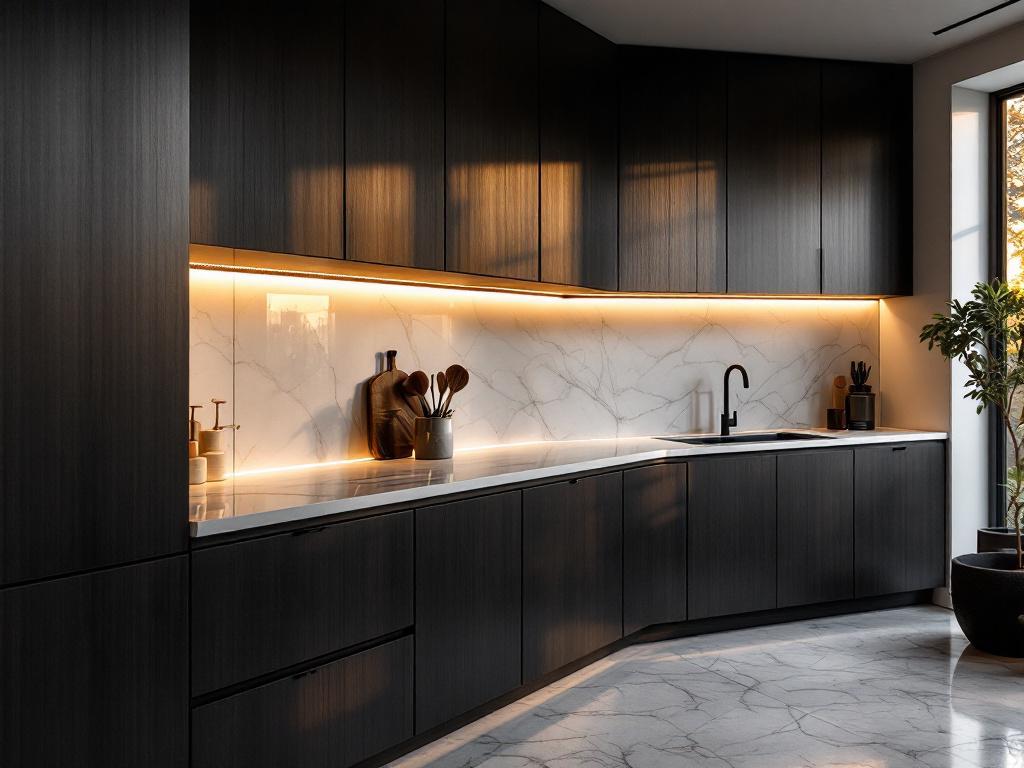
A luxury kitchen remodel is not simply a larger version of a standard kitchen renovation. It is a highly coordinated project involving design, custom cabinetry, premium materials, appliances, skilled trades, lighting, plumbing, electrical systems, and often architectural changes.
That is why asking, “How much does a luxury kitchen remodel cost?” does not have one universal answer.
In the United States and Canada, the final investment can vary considerably depending on where the property is located, how extensive the renovation is, the level of cabinetry and materials selected, whether the layout changes, and how much work is required behind the walls.
For homeowners planning a luxury kitchen remodel, the more useful question is not simply what the project costs. It is what factors determine the cost—and which decisions have the greatest impact on the final result.
This guide explains the major cost drivers behind luxury kitchen renovations in the U.S. and Canada, how to think about a realistic budget, and what to consider before beginning a high-end kitchen project.

What Determines the Cost of a Luxury Kitchen Remodel Cost?
Several major components influence the overall investment in a luxury kitchen.
These typically include:
- Custom cabinetry
- Countertops and other surfaces
- Appliances
- Design and architectural services
- Skilled labor and installation
- Plumbing and electrical work
- Lighting
- Flooring and wall finishes
- Ventilation
- Permits and inspections
- Structural changes
- Delivery and site logistics
- Project management
- Unexpected conditions discovered during construction
The important point is that these elements are interconnected.
For example, changing the location of a sink may require plumbing modifications. Moving a range may affect gas, electrical, ventilation, and cabinetry. Removing a wall can introduce structural engineering and permitting requirements.
In other words, the price of a luxury kitchen remodel is shaped not only by what you can see, but also by what needs to happen behind the finished surfaces.
What is the average cost of a luxury kitchen?
There is no single average that accurately represents every luxury kitchen in the United States and Canada.
A high-end kitchen in a major metropolitan market can have a very different budget from a comparable project in a smaller city. The scope of construction, availability of skilled trades, material selection, property conditions, and local permitting requirements can all change the final investment.
Instead of relying on one national number, homeowners should think about their project in terms of scope and specification.
A kitchen with custom cabinetry, premium appliances, natural stone, extensive electrical work, and a completely new layout will naturally require a different level of investment from a project that keeps the existing footprint.
The size of the room also matters, but square footage alone does not determine the budget.
A relatively compact kitchen with highly customized cabinetry and premium materials can require more investment than a larger kitchen with a simpler specification.
For that reason, a professional luxury kitchen design consultation should begin by understanding the project rather than immediately assigning a price.
What are the biggest factors that affect luxury kitchen remodeling costs?

1- Custom Cabinetry
Cabinetry is often one of the most significant components of a high-end kitchen renovation.
Luxury cabinetry differs from stock or semi-custom products in both construction and design flexibility.
Custom systems can be developed around the exact dimensions of the room, ceiling height, appliances, storage requirements, architectural details, and personal preferences.
The cost is influenced by:
- Cabinet dimensions
- Door construction
- Interior organization
- Wood species and veneers
- Paint and finishing systems
- Hardware
- Integrated lighting
- Specialty storage
- Full-height cabinetry
- Curved or unusual elements
- Appliance integration
- Installation complexity
This is why comparing cabinet prices without comparing specifications can be misleading.
Two kitchens may appear similar from the outside while having completely different levels of construction, hardware, finish quality, and customization.
2- Countertops and Surface Materials
Countertops can have a significant impact on the overall specification of a luxury kitchen.
Natural stone, quartzite, premium engineered surfaces, porcelain, and other architectural materials can vary considerably in material availability, fabrication requirements, thickness, edge profiles, and installation complexity.
Large islands can also require more material and more sophisticated fabrication.
Details such as waterfall edges, bookmatched slabs, integrated sinks, unusual cutouts, and highly visible seams can further influence fabrication requirements.
For a sophisticated kitchen, material selection should therefore consider both appearance and performance.
3- Appliances
Appliances represent another major variable.
A luxury kitchen may include built-in refrigeration, professional cooking equipment, multiple ovens, steam appliances, wine storage, specialty refrigeration, integrated dishwashers, or other highly specified systems.
But the most expensive appliance package is not necessarily the best choice.
The better approach is to select appliances according to the homeowner’s cooking habits and integrate them into the architectural design.
An appliance that requires a particular cabinet dimension or ventilation system should be considered early rather than after the cabinetry has already been designed.
4- Labor and Installation
High-end materials require high-quality installation.
Precision cabinetry, large-format stone, integrated appliances, custom millwork, electrical systems, plumbing, and lighting all require specialized trades.
Labor costs vary significantly throughout the U.S. and Canada. Major metropolitan and coastal markets can have considerably different labor and project costs than smaller markets.
The complexity of access can also matter.
A high-rise condominium, historic home, tightly constrained urban property, or residence with difficult delivery access may require considerably more coordination than a new suburban property.
5- Changing the Kitchen Layout
One of the most important cost considerations is whether the existing layout stays intact.
Keeping plumbing, electrical connections, appliances, and walls in approximately the same locations can simplify the project.
Moving them can introduce additional work.
Common examples include:
- Relocating a sink
- Moving a range
- Adding electrical circuits
- Changing ventilation
- Removing walls
- Creating a larger island
- Changing doorways
- Modifying windows
- Moving gas lines
- Reconfiguring flooring
The more the architecture changes, the more important early planning becomes.
6- Electrical, Plumbing, and Mechanical Systems
A luxury kitchen depends on infrastructure that is often invisible after completion.
Modern appliances may require dedicated electrical capacity. Large cooking systems may require specialized ventilation. New sinks, dishwashers, water filtration, or pot fillers can require plumbing changes.
Ventilation is especially important in high-performance kitchens because the hood, ductwork, makeup air, and building conditions may need to be considered together.
These systems should be coordinated before cabinetry production begins.
7- Design and Architectural Services
A high-end kitchen is rarely just a cabinet order.
Depending on the project, the design process may involve:
- Kitchen designers
- Interior designers
- Architects
- Engineers
- General contractors
- Cabinet manufacturers
- Stone fabricators
- Electricians
- Plumbers
- HVAC professionals
The more complex the renovation, the more important coordination becomes.
Good design can prevent expensive mistakes before construction begins.

What is the most expensive part of remodeling a kitchen?
There is no single component that is always the most expensive.
For many high-end projects, custom cabinetry and skilled labor are among the largest budget components, while premium appliances, countertops, structural work, and mechanical changes can also become major expenses depending on the scope. Industry cost guides consistently identify cabinetry, labor, appliances, surfaces, and infrastructure as major drivers.
However, the most expensive part of one kitchen may not be the most expensive part of another.
For example, a project with a simple layout but extremely customized cabinetry may allocate more toward millwork.
Another project may involve removing walls, relocating plumbing, upgrading electrical capacity, and redesigning ventilation. In that case, construction and infrastructure can become a much larger portion of the investment.
This is why a meaningful budget should be developed from the scope of work, rather than from a generic cost-per-square-foot calculation.
How much remodeling can be done with $100,000?
A $100,000 kitchen remodeling budget can represent very different levels of work depending on the location, size of the kitchen, existing conditions, and specification.
Rather than assuming that a fixed budget guarantees a particular result, homeowners should establish priorities.
For example, a project might prioritize:
Option 1: Cabinetry and Design
Keep the existing layout while investing heavily in custom cabinetry, storage, hardware, and architectural detailing.
Option 2: Complete Material Upgrade
Keep much of the existing infrastructure while upgrading cabinetry, countertops, appliances, lighting, and finishes.
Option 3: Layout Transformation
Allocate more of the budget toward construction, plumbing, electrical, ventilation, and architectural changes while carefully selecting finishes.
Option 4: Balanced Luxury
Distribute the investment across cabinetry, surfaces, appliances, lighting, and construction rather than maximizing one category.
The right strategy depends on the property.
A $100,000 budget can produce a sophisticated result when the scope is controlled and the money is directed toward the elements that matter most.
But attempting to completely restructure a kitchen, move major infrastructure, specify premium materials, purchase a large appliance package, and add extensive custom millwork within the same budget may require compromises.
The key is prioritization.
What is a realistic budget for a kitchen remodel?
A realistic budget begins with a realistic scope.
Before establishing a number, homeowners should answer several questions:
Are you changing the layout?
A cosmetic renovation is fundamentally different from a full architectural remodel.
Are you replacing the cabinetry?
Custom cabinetry can significantly change the project specification.
Are you upgrading the appliances?
Professional and integrated appliances can introduce additional design and infrastructure requirements.
Are plumbing and electrical systems moving?
Infrastructure changes can increase labor, coordination, and permitting requirements.
Are you changing walls or windows?
Structural or architectural modifications require additional planning and professional coordination.
What level of materials do you want?
There is a substantial difference between standard, premium, and highly specialized materials.
Where is the property located?
Labor availability, local regulations, material logistics, and market conditions vary between cities and regions in the U.S. and Canada.
A realistic budget is therefore not simply an amount selected at the beginning of the project.
It is the financial expression of the design brief.
Does kitchen size determine the cost?
Kitchen size matters, but it should not be used as the only way to estimate a luxury renovation.
A larger kitchen generally requires more cabinetry, countertops, flooring, lighting, and potentially more appliances.
However, complexity can be more influential than size.
A smaller kitchen with:
- Fully custom cabinetry
- Integrated appliances
- Premium stone
- Specialized hardware
- Detailed millwork
- Complex lighting
- High-performance ventilation
can require a substantial investment despite its relatively small footprint.
Conversely, a larger kitchen with a straightforward layout and restrained specification may be less complex.
This is why cost-per-square-foot figures should be treated as rough planning tools rather than precise estimates.

How location affects kitchen remodeling costs in the U.S. and Canada
Location is one of the most important variables in a renovation.
Labor rates, permitting requirements, construction standards, transportation, material availability, property access, and demand for specialized trades can vary significantly between markets.
For example, a luxury renovation in a major metropolitan market may require more expensive specialized labor and more complicated logistics than a similar project in a smaller community.
Canadian projects can also involve different procurement, transportation, taxation, and installation considerations compared with U.S. projects.
Even within the same country, the difference between markets can be significant.
This is why a realistic budget should always be developed around the actual property and local project conditions.
Why custom cabinetry changes the way you think about budget
In a standard kitchen renovation, cabinets can be treated primarily as a product.
In an architectural luxury kitchen, cabinetry becomes part of the architecture.
It determines:
- Visual rhythm
- Storage capacity
- Appliance integration
- Circulation
- Material transitions
- Lighting integration
- Wall proportions
- Overall character
Custom cabinetry therefore affects much more than storage.
It can determine how the entire kitchen looks and functions.
This is particularly important in open-plan homes where the kitchen is visible from living and dining areas.
The cabinetry needs to feel like part of the architecture rather than furniture placed inside it.
Where should homeowners spend more—and where can they simplify?
Not every part of a kitchen needs to be equally expensive.
A smart luxury renovation identifies the details that have the greatest impact.
Spend more on:
- Custom cabinetry
- High-quality hardware
- Durable surfaces
- Professional installation
- Lighting design
- Proper ventilation
- Appliances that match your lifestyle
- Architectural planning
- Decorative elements that add little function
- Trend-driven finishes
- Unnecessary structural changes
- Appliances that you will rarely use
- Overly complicated materials
- Features that create maintenance without meaningful benefit
Luxury is not about maximizing every category.
It is about making every important decision deliberately.
How Kasa Di Lusso Can Help With Your Luxury Kitchen Remodel
Kasa Di Lusso approaches the kitchen as an architectural system rather than an off-the-shelf cabinetry package.
The company provides bespoke kitchen design and manufacturing, architectural millwork and integrated cabinetry, design and material consultation, manufacturing-only or partial-service support, and project-dependent site coordination and installation support.
Its approach combines modern European design direction with custom manufacturing and premium European hardware. Kasa Di Lusso currently serves qualified residential and development projects across Canada and the United States.
Design From the Inside Out
Kasa Di Lusso’s philosophy is that practical requirements should inform architectural decisions.
That means considering storage, circulation, appliances, work zones, ergonomics, and everyday use before finalizing the visual language of the kitchen.
Fully Customized Cabinetry
Kasa Di Lusso does not offer off-the-shelf or modular cabinetry. Its cabinetry systems are developed specifically for each project.
Material and Design Consultation
Material selection is considered as part of the larger architectural composition, helping homeowners create a coherent relationship between cabinetry, surfaces, hardware, appliances, and the surrounding home.
Technical Coordination
The company operates through a coordinated design and manufacturing model, allowing design direction, production, and technical execution to work together rather than functioning as disconnected stages.
Support for Homeowners and Professionals
Kasa Di Lusso works with private homeowners as well as architects, builders, and developers seeking bespoke cabinetry, millwork, and technical coordination.
For a homeowner, this approach can make the process more structured: instead of choosing cabinets first and trying to make the rest of the kitchen work around them, the project can be developed as a complete architectural system.

How to Plan Your Luxury Kitchen Remodeling Budget
Before requesting proposals, prepare a clear project brief.
Include:
1- Your goals
What do you want the new kitchen to accomplish?
2- Your preferred style
Modern, transitional, minimalist, traditional, European, or another architectural direction.
3- Your must-have features
Island, professional range, integrated refrigeration, pantry, beverage station, hidden storage, or other requirements.
4- Your existing conditions
Share photographs, measurements, floor plans, and information about the current kitchen.
5- Your desired level of customization
Determine whether you are looking for semi-custom products or a fully bespoke cabinetry system.
6- Your target investment
A clear financial framework allows the design team to make appropriate decisions early.
7- Your timeline
Custom manufacturing, construction, shipping, installation, and coordination all require planning.
The clearer the brief, the easier it becomes to compare proposals based on actual scope rather than comparing disconnected product prices.
Luxury Kitchen Remodeling Is About More Than the Price
The cost of a luxury kitchen remodel is ultimately the result of dozens of interconnected decisions.
Cabinetry matters.
Materials matter.
Appliances matter.
Labor matters.
Infrastructure matters.
Location matters.
But perhaps the most important factor is how these elements are coordinated.
A well-designed kitchen can use a substantial investment intelligently, directing resources toward craftsmanship, functionality, durability, and architectural coherence rather than unnecessary excess.
That is what turns a renovation into a long-term investment in the home.
Frequently Asked Questions About Luxury Kitchen Remodeling

1- What is the average cost of a luxury kitchen?
There is no universal average that accurately applies to every luxury kitchen in the U.S. and Canada. The final investment depends on cabinetry, materials, appliances, labor, location, layout changes, infrastructure, permitting, and project complexity.
2- What is the most expensive part of remodeling a kitchen?
Custom cabinetry and labor are often among the largest components, but the answer depends on the project. Structural changes, premium appliances, stone fabrication, plumbing, electrical work, and ventilation can become major expenses as well.
3- How much remodeling can be done with $100,000?
A $100,000 budget can support different levels of remodeling depending on location and scope. It may be possible to create a highly refined kitchen by prioritizing custom cabinetry and finishes while maintaining the existing layout. A complete structural transformation with extensive infrastructure changes may require a different budget.
4- What is a realistic budget for a kitchen remodel?
A realistic budget should be based on the actual scope of work rather than a generic national average. Homeowners should consider cabinetry, appliances, surfaces, labor, design, infrastructure, permits, logistics, and contingency before establishing the final investment.
5- How can I reduce the cost of a luxury kitchen remodel without compromising quality?
One of the best strategies is to prioritize. Keep the existing layout when possible, invest in cabinetry and craftsmanship where they have the greatest visual and functional impact, select materials strategically, and avoid unnecessary structural changes or trend-driven features.
Final Thoughts
A luxury kitchen remodel is a significant investment, but the most successful projects are not necessarily the ones with the largest budgets.
They are the projects where the budget is aligned with the design.
When cabinetry, materials, appliances, lighting, architecture, and infrastructure are considered together, homeowners can create a kitchen that feels refined without relying on excess.
For projects in the United States and Canada, understanding the local construction environment and defining the scope early are essential.
And when the kitchen is treated as architecture rather than simply a collection of cabinets, the result can be more functional, more cohesive, and more enduring.
That is where thoughtful design creates real value.